Measure baseline
Portable VOC meter reads formaldehyde + total VOC level in the unit. We log it before we touch anything.
Headaches, eye irritation, the "new-furniture smell" that won't leave. Japanese-system photocatalyst treatment on carpentry, cabinet and wardrobe interiors — where renovation off-gas concentrates — with VOC readings before and after.


Tell us the unit size and what's new (furniture, reno) — we send a fixed price to your WhatsApp.



A few of our 4.8★ reviews from Singapore homeowners and businesses.
"Detailed cleaning and formaldehyde removal after our renovation. The crew worked over 9 hours across 5 levels; the air smelled noticeably cleaner and it gave us peace of mind before moving in."
Google review
"Post-reno clean with floor scrubbing and formaldehyde removal — the pungent choking smell in all my carpentry is gone, and my floor no longer has that powdery feeling."
Google review
"Chester, Ruman, Sharif and Najeen did a fantastic deep clean — they even measured the before-and-after air quality and the improvement was significant."
Google review
Photocatalyst spray on carpentry and cabinet interiors, with measurement before and after. Written out so you know exactly what's done, and what isn't.
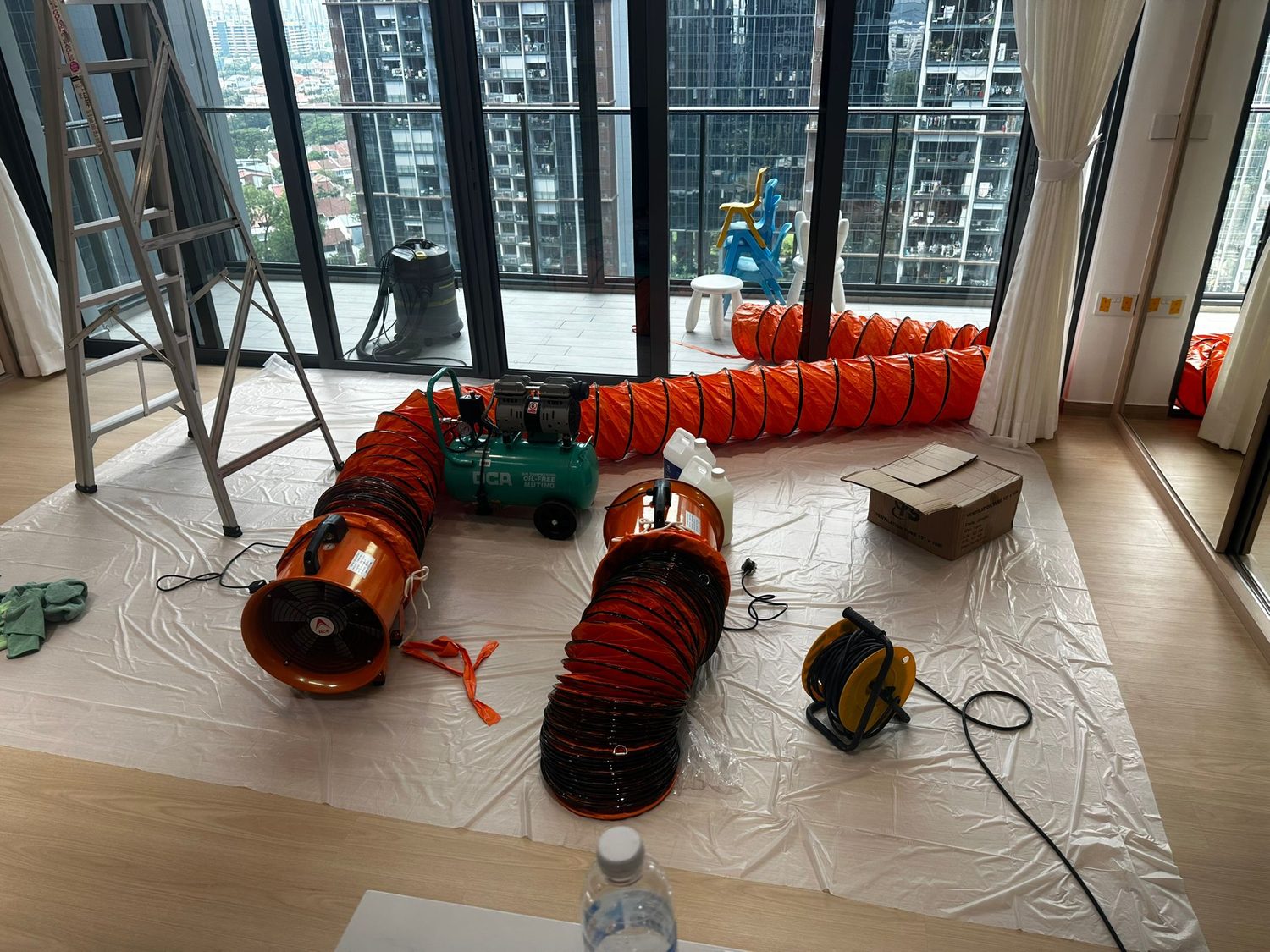
The Japanese-system protocol — measure, spray, cure, measure. We share the readings with you.
Portable VOC meter reads formaldehyde + total VOC level in the unit. We log it before we touch anything.
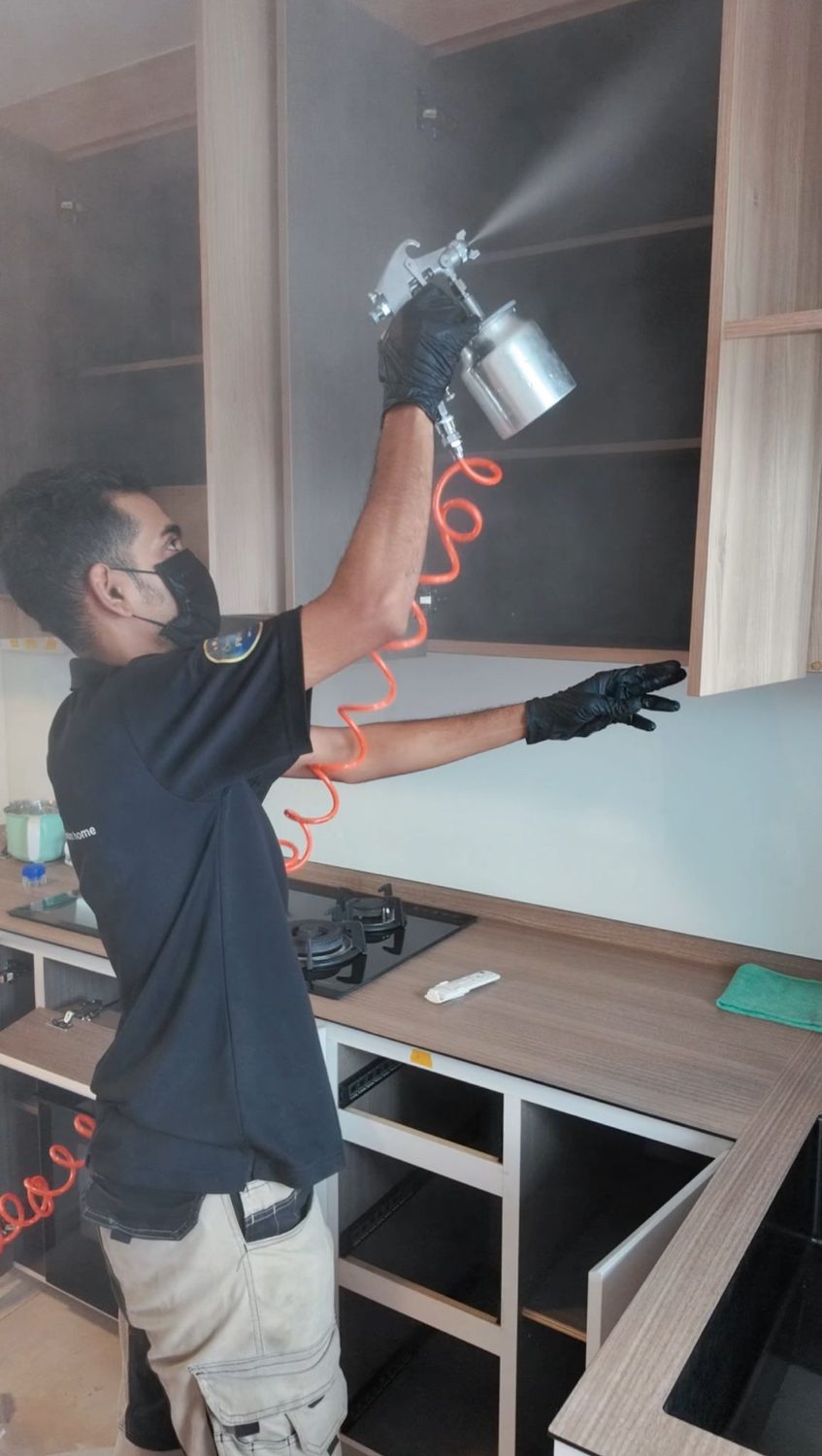
Titanium-dioxide solution misted onto built-in carpentry, cabinet interiors and wardrobe shelves. Light-activated — breaks down VOCs continuously after application.
30–60 minute cure window with air circulation, so the photocatalyst binds to the treated surfaces before the space is used again.
VOC reading taken again. Numbers shared. Aftercare instructions: ventilate, don't wipe surfaces for 24 hours so the photocatalyst binds.
Formaldehyde concentrates where composite wood, adhesives and new paint meet enclosed air. This treatment covers the carpentry. The other two are outside its scope.
MDF, particleboard, plywood. Urea-formaldehyde adhesives off-gas for months. Cabinet interiors are sprayed first — that's where the concentration peaks.
Solvent-based paint and tile adhesive release VOCs during cure. Walls, ceilings and paint surfaces are not part of this treatment.
New foam mattresses and sofas off-gas for weeks. Mattress and sofa surfaces are not part of this treatment.
We send the full fixed number after we see your form — shaped by four things, never topped up on the day.
Formaldehyde is a colourless gas that is commonly released from renovation materials and household furnishings. It can be found in:
Newly renovated homes often experience higher formaldehyde and VOC (Volatile Organic Compound) levels because these materials continue releasing gases into the indoor environment after installation.
Volatile Organic Compounds (VOCs) are gases emitted from various building materials, furnishings, cleaning products, paints, and adhesives.
Common VOCs include:
High VOC concentrations may affect indoor air quality and are commonly found in newly renovated homes, offices, and commercial spaces.
Exposure to elevated formaldehyde levels may cause symptoms such as:
Individuals who are more sensitive, such as young children, elderly family members, pets, and those with respiratory conditions, may experience stronger reactions.
The severity of symptoms depends on factors such as concentration levels, duration of exposure, and individual sensitivity.
Formaldehyde can continue off-gassing from renovation materials and furniture for months or even years after installation.
The off-gassing rate depends on factors such as:
Many homeowners notice stronger formaldehyde odours during the first few months after renovation, especially when large amounts of built-in carpentry are present.
Opening windows improves ventilation and can help reduce indoor formaldehyde concentrations temporarily.
However, ventilation alone does not stop formaldehyde from being continuously released from renovation materials and furniture.
As long as the source materials remain present, formaldehyde off-gassing may continue over time.
The ideal time is after renovation works have been fully completed and after post renovation cleaning has been carried out.
This ensures that:
Many homeowners schedule formaldehyde treatment shortly before moving into their newly renovated property.
Professional formaldehyde and VOC treatment involves applying specialised solutions designed to help neutralise and reduce airborne contaminants and surface emissions.
Our treatment is applied to:
Mattress and sofa surfaces, and walls, ceilings and paint surfaces, are not in scope.
The objective is to improve indoor air quality and reduce the concentration of harmful airborne compounds within the property.
Not necessarily.
Formaldehyde and VOCs can be present even when there is little or no noticeable odour.
Some renovation materials release contaminants at levels that are not easily detected by smell alone.
Air quality testing is the most reliable way to determine indoor formaldehyde and VOC levels.
No treatment can permanently stop all future off-gassing from source materials.
However, professional formaldehyde and VOC treatments can help significantly reduce existing contamination and improve indoor air quality.
As renovation materials continue to age, natural off-gassing levels generally decrease over time.
Professional formaldehyde treatment solutions are generally designed for indoor residential use.
However, occupants, children, and pets are typically advised to avoid treated areas during the treatment process and until the recommended ventilation period has been completed.
Specific recommendations may vary depending on the products and treatment methods used.
Common indicators may include:
However, symptoms alone are not reliable indicators.
The most accurate way to assess indoor air quality is through formaldehyde and VOC testing using professional air quality monitoring equipment.
Air purifiers help filter airborne particles and may reduce certain airborne contaminants while operating.
Formaldehyde treatment focuses on addressing formaldehyde and VOC emissions at their source, particularly on surfaces and materials that release these compounds.
Many homeowners choose to combine formaldehyde treatment with good ventilation and air purification for improved indoor air quality.
Many homeowners choose formaldehyde and VOC treatment after renovation because newly installed carpentry, furniture, laminates, paints, adhesives, and flooring materials may release formaldehyde and other VOCs into the indoor environment.
A professional treatment can help improve indoor air quality, especially in homes with extensive built-in carpentry, young children, elderly family members, pets, or individuals who are sensitive to airborne pollutants.
While formaldehyde treatment cannot prevent future off-gassing entirely, it can help reduce existing contaminants and create a more comfortable living environment.
The cost of formaldehyde and VOC treatment in Singapore depends on several factors, including:
Smaller apartments generally require less treatment compared to larger HDB flats, condominiums, landed properties, offices, or commercial spaces.
For an accurate quotation, homeowners are encouraged to provide their floor plan and renovation details for assessment.
Young children and babies may be more sensitive to indoor air pollutants because their respiratory systems are still developing.
Exposure to elevated formaldehyde levels may cause symptoms such as:
Many parents choose to perform formaldehyde treatment before moving into a newly renovated home to improve indoor air quality and provide a more comfortable environment for their children.
Pets spend a significant amount of time indoors and may also be exposed to indoor air pollutants released from renovation materials and furniture.
Because pets are often closer to flooring, cabinetry, and other treated surfaces, many homeowners choose formaldehyde and VOC treatment as part of their move-in preparation after renovation.
The waiting period depends on the extent of renovation works, ventilation conditions, and the amount of new materials installed.
Many homeowners choose to:
Homes with extensive carpentry and custom-built furniture may benefit from additional ventilation time before occupancy.
Yes. Many carpentry materials use engineered wood products that may contain formaldehyde-based resins.
Examples include:
The amount of formaldehyde released depends on the material quality, manufacturing standards, age of the product, temperature, and humidity levels.
New furniture may release formaldehyde and VOCs, particularly if it contains engineered wood products, laminates, adhesives, or coatings.
Common sources include:
This is one reason why new furniture often has a noticeable "new furniture smell."
Formaldehyde cannot usually be eliminated permanently because many materials continue to release small amounts over time.
However, formaldehyde and VOC treatment, combined with proper ventilation and good indoor air management, can help significantly reduce indoor concentrations and improve overall air quality.
Most materials naturally release less formaldehyde as they age.
Some homeowners notice:
However, poor indoor air quality is not always detectable by smell alone. Professional air quality testing provides the most accurate assessment.
Air conditioning systems help circulate indoor air and improve comfort but generally do not remove formaldehyde at the source.
Because formaldehyde is continuously released from certain renovation materials and furniture, additional measures such as ventilation, air purification, and formaldehyde treatment may be required to reduce indoor concentrations.
Some studies suggest that certain indoor plants may absorb small amounts of airborne pollutants.
However, houseplants alone are generally not sufficient to significantly reduce formaldehyde levels in newly renovated homes with multiple emission sources.
They are best used as a complementary measure alongside proper ventilation and professional treatment.
Formaldehyde treatment focuses on reducing formaldehyde and VOC emissions that affect indoor air quality.
Disinfection focuses on reducing bacteria, viruses, and microorganisms on surfaces.
These are separate services designed to address different concerns within a property.
Low-VOC materials can help reduce indoor pollutant levels, but they may not completely eliminate formaldehyde or other airborne compounds.
Other renovation materials, furnishings, adhesives, paints, and furniture may still contribute to indoor air pollution.
Many homeowners still choose formaldehyde treatment as an additional precaution after renovation.
Professional treatment provides a targeted approach to improving indoor air quality after renovation.
Benefits may include:
This is particularly beneficial for families with children, pets, elderly family members, or individuals sensitive to indoor air pollutants.
Tell us the unit size and what's new. We send full scope and fixed price to your WhatsApp.
Part of our Post-Renovation range — one in-house crew, one fixed price across every service.