Bottom line up front: a Singapore office is cleaned in one of three ways. A part-time cleaner you employ suits a small, tidy unit. A contract with a cleaning company adds a written scope, cover when someone is off, and the equipment. An ad-hoc deep clean handles what neither touches: pantry build-up, washroom scale, carpet and hard floors. Most offices use two of the three.
TL;DR
- Part-time cleaner: you become the employer. MOM treats anyone contracted for under 35 hours a week as a part-time employee under the Employment Act.
- Contract cleaning: the provider must hold a cleaning business licence from NEA, and you can check it on NEA's public list.
- Deep cleans of pantries, washrooms, carpets and hard floors run on a separate cycle from daily upkeep.
- Get the exclusions in writing before you sign. That is where charges on the day come from.
- Size the cleaning on how the office is used: headcount, pantry use, washrooms, floor type and hours, not floor area alone.
The three ways a Singapore office gets cleaned
Every office ends up with some mix of the same three arrangements. The difference is who carries the work of managing it.
| Model | Who it suits | What you manage |
|---|---|---|
| Part-time cleaner you employ | Small, lightly used units with someone on site who can supervise | Hiring, the employment contract, leave cover, equipment, chemicals and consumables |
| Contract with a cleaning company | Offices that want a fixed scope, cover and one invoice | The scope document and the working relationship |
| Ad-hoc deep clean | Every office, on a cycle or before a move, audit, event or handover | Booking the slot and clearing the space |
The three are not exclusive. A common set-up is a part-timer or a contract for daily upkeep, plus a deep clean every few months for the jobs daily cleaning never reaches.
What a part-time cleaner actually covers
A part-time cleaner covers whatever you write into the job, during the hours you pay for, with the supplies you buy. That is the strength of the arrangement and its limit.
Under the Employment Act, a part-time employee is someone contracted to work less than 35 hours a week. MOM requires the contract to state the hourly basic and gross rates of pay, the working hours per day or week, and the working days per week or month. Hiring a part-timer directly makes your company the employer, with the pay, leave and record-keeping that come with it.
There is a wage rule to check as well. Since 1 September 2022, the Progressive Wage Model for cleaning covers local in-house cleaners, and firms that employ foreign workers must pay their local employees the applicable Progressive Wage rates. MOM makes this a condition for work pass applications and renewals.
The practical gaps show up quickly. When the cleaner is sick or on leave, nobody cleans. The equipment is whatever the office has bought, usually a household vacuum and a mop. And one person working alone in a few hours a day tends to keep surfaces tidy while washroom scale, pantry grease and carpet grime build up underneath.
What a contract with a cleaning company changes
A contract moves the employment, the cover and the equipment onto the provider, and puts the scope in writing.
In Singapore, any business offering general cleaning at non-domestic premises must hold a cleaning business licence from the National Environment Agency before it starts work. Licensing has been mandatory since 2014. NEA's licence conditions include paying resident cleaners Progressive Wage Model wages, training them, and issuing written employment contracts and itemised payslips. Operating without a licence carries a fine of up to S$10,000.
Since 1 January 2024, licences come in three classes. Class 2 requires bizSAFE certification and at least S$25,000 in paid-up capital. Class 1 adds a workforce trained in at least three WSQ modules and S$250,000 in paid-up capital. Class 3 is a transitional tier. The class tells you the baseline a provider has met before you have seen any of its work.
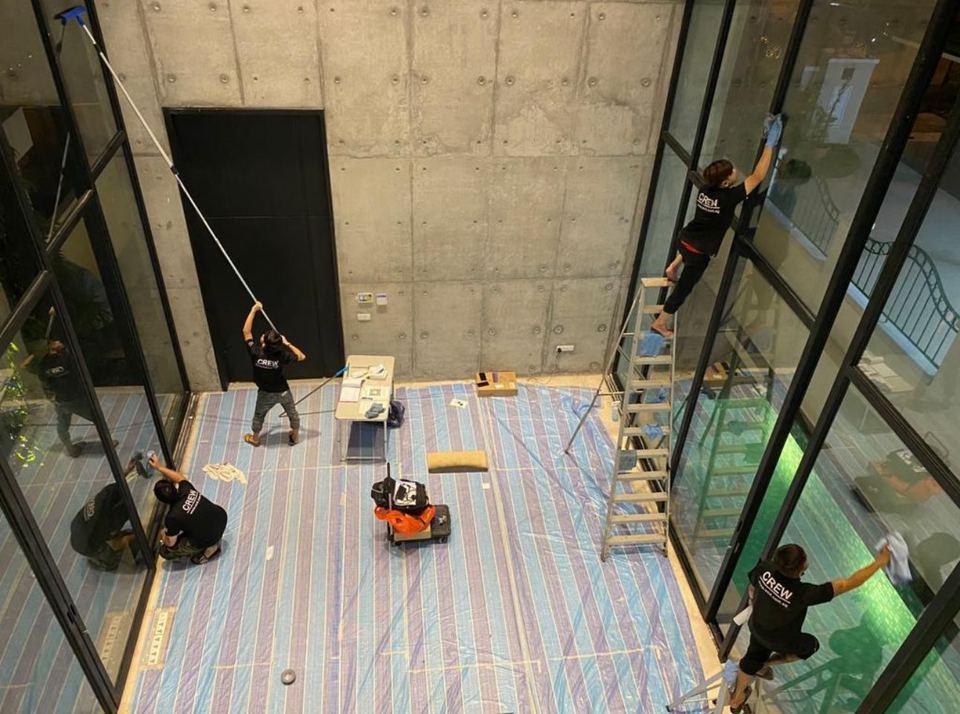
At OCD, a recurring office contract starts with one walk-through. We write the scope, quote a fixed monthly price in writing, and agree the frequency and the slot: daily, three times a week, weekly or fortnightly, and before 9am, at lunch or after 7pm. Recurring contracts get a dedicated in-house crew that learns your space. The crew brings its own equipment and chemicals, and the invoice cycle is set to suit your finance team.
Where the deep clean sits
A deep clean covers the jobs daily cleaning cannot do in the time it has. These are the four that matter in most offices:
- Pantry. Sink descaled, microwave cleaned inside, fridge handles and coffee-machine area degreased, cabinet fronts wiped. On OCD contracts the pantry gets this treatment on every visit, not once a month.
- Washrooms. Bowls, urinals, basins and floors descaled, vents and mirrors done. Our toilet and washroom deep cleaning handles washrooms that have gone past what a routine wipe can recover.
- Carpet. Vacuuming keeps the surface clean. Hot-water extraction pulls out what has settled into the pile, and we quote it separately through our upholstery and carpet service.
- Hard floors. Tile, vinyl and epoxy floors go grey in the texture even when they are mopped daily. Machine floor scrubbing for large areas fixes that, and our guidance for commercial premises is a scrub every three to six months, more often in high-traffic zones.
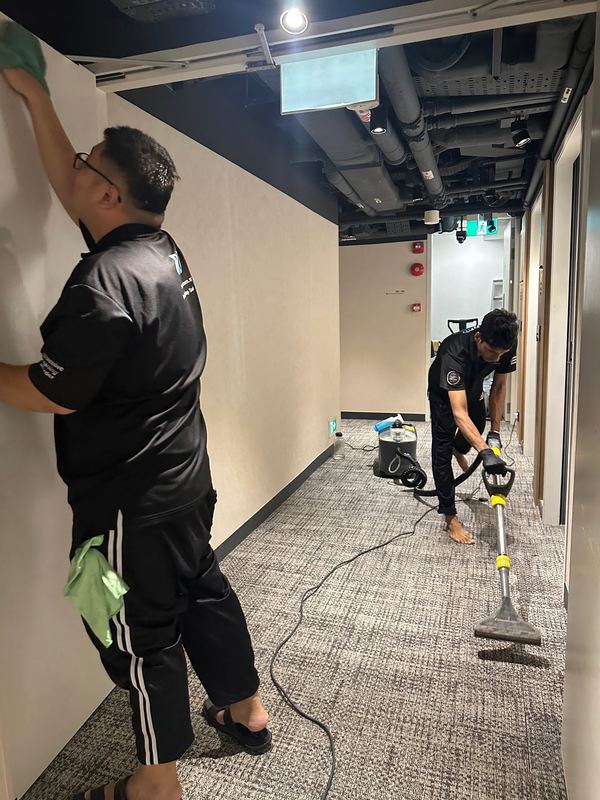
A deep clean is also the right booking for one-off occasions: an office move, a renovation, a pre-event clean or a handover at the end of a lease. If the occasion is a renovation, read what post-renovation cleaning covers first, because construction dust is a different job.
What is usually left out, and gets billed on the day
The list of items that turn into extra charges is short and predictable. Ask about each one before you sign.
- Carpet hot-water extraction
- Machine floor scrubbing, and vinyl or marble floor restoration
- Disinfection treatment after an illness case
- External façade and exterior windows above ground floor, which is a specialist trade
- Consumables: toilet rolls, hand soap and bin liners
- Inside drawers, on laptops and on server hardware
On an OCD office contract, the first four are quoted separately and written into the quote, so you see them before any visit. Workstations are dusted and wiped, while laptops are left alone unless you ask, and in server and IT rooms only the surfaces are wiped, with the hardware left alone. If you are deciding whether you need workplace disinfection at all, our guide to disinfection vs cleaning explains when it earns its place.
How to size office cleaning
Size it on how the office is used, not on floor area alone. Five inputs decide the frequency and the crew.
| Input | Why it matters |
|---|---|
| Headcount and visitors | More people means more pantry, washroom and bin load every day |
| Pantry use | A pantry where staff eat lunch needs daily attention. A coffee point does not |
| Washrooms inside your unit | In many multi-tenant buildings the common washrooms are the building's job and you pay only for those inside your unit. Check your lease |
| Floor type | Carpet needs vacuuming and periodic extraction. Tile, vinyl and epoxy need mopping and periodic machine scrubbing |
| Working hours | Cleaning before 9am or after 7pm avoids disruption, and it fixes the slot the crew works to |
As a starting point, high-traffic and client-facing offices with shared pantries usually justify daily cleaning. Small teams in quieter units are often well served by two or three visits a week plus a quarterly deep clean. Our office cleaning cost guide covers how frequency moves the monthly price.
Questions to ask any provider before signing
Take this list to every quote, ours included.
- Is the company on NEA's list of licensed cleaning businesses, and which class does it hold?
- Is the crew employed by the company, or subcontracted job by job?
- What happens when the regular cleaner is off?
- Who supplies the equipment, the chemicals and the consumables?
- What does each visit cover, and what runs monthly or quarterly?
- What is excluded, and how is it priced?
- How do you report a missed item, and how fast is it put right?
- What is the contract term, and what is the notice period?
Figures and sources
- 1,858 businesses were on NEA's list of licensed cleaning businesses dated 28 September 2026, and 257 of them held a Class 1 licence. Source: NEA, list of licensed cleaning businesses.
- Since 2014, general cleaning businesses must be licensed, and operating without a licence carries a fine of up to S$10,000. Source: NEA, Cleaning Business Licence.
- Three licence classes from 1 January 2024, with S$25,000 (Class 2) and S$250,000 (Class 1) paid-up capital requirements. Source: NEA, 9 January 2023.
- Under 35 hours a week is the Employment Act line for a part-time employee. Source: MOM, Who is a part-time employee.
- 1 September 2022: the Progressive Wage Model for cleaning was extended to local in-house cleaners. Source: MOM, Expansion of Progressive Wage coverage.
Frequently asked questions
Should a small office hire a part-time cleaner or a cleaning company?
A part-time cleaner suits a small, lightly used unit where someone in the office can supervise and cover absences. A cleaning company suits an office that wants a written scope, cover when the regular cleaner is off, and equipment and chemicals supplied. Many small offices use a part-timer or a contract for daily upkeep and add a periodic deep clean.
Does an office cleaning company need a licence in Singapore?
Yes. A business offering general cleaning at non-domestic premises such as offices must hold a cleaning business licence from the National Environment Agency (NEA) before it starts work. NEA publishes a list of licensed cleaning businesses, so you can check a provider's name and licence class before you sign.
How often does an office need cleaning?
It depends on use. High-traffic, client-facing offices with shared pantries and washrooms usually justify daily cleaning. Small teams in low-traffic units are often well served by two or three visits a week, plus a deep clean every quarter or so. Carpets and hard floors run on their own, longer cycle.
Who supplies the equipment and chemicals for office cleaning?
With a part-time cleaner you employ, the office buys the equipment, chemicals and consumables. With a cleaning company it depends on the contract. OCD's crew brings its own equipment and chemicals. Consumables such as toilet rolls, hand soap and bin liners should be named in any contract so both sides know who restocks them.
What does an office deep clean cover that daily cleaning does not?
A deep clean reaches the build-up that daily cleaning has no time for: pantry grease and scale, washroom descaling, carpet hot-water extraction, and machine scrubbing of tile, vinyl or epoxy floors. It is also booked for one-off occasions such as an office move, a renovation, an event or a handover.
What to do next
If you are weighing a part-timer against a contract, start by writing down what gets missed today. Most of our office clients start with one walk-through: we see the space, you tell us what gets neglected, and we send a fixed price with the full scope in writing. See how recurring contracts are set up on our office cleaning in Singapore page, or browse the full cleaning service range.
Get your office cleaning fixed price
Send your office size, headcount and preferred slot. We walk the space and send a fixed price with the full scope in writing.